
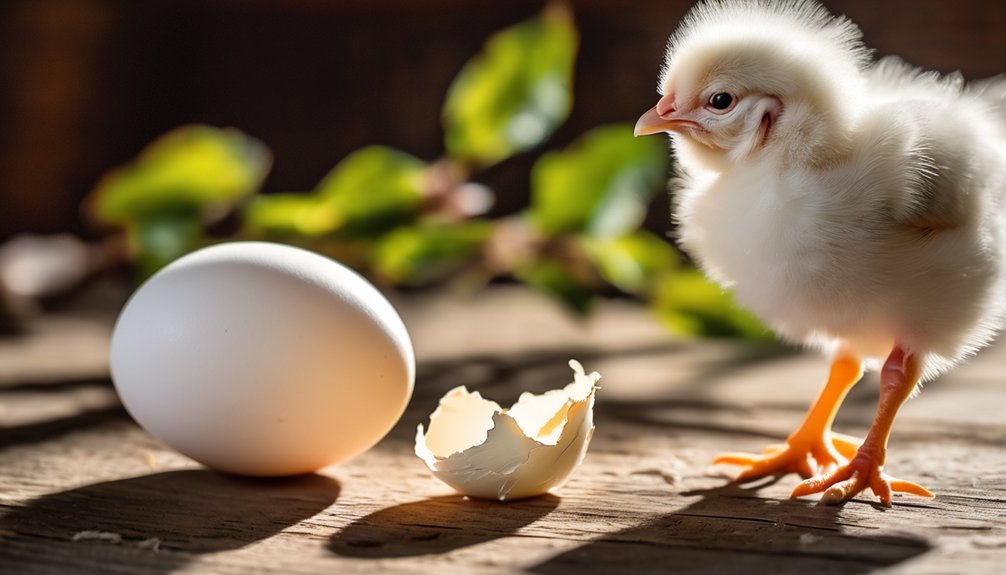

You might wonder whether the chicken or the egg came first, but science offers a clear answer through evolutionary biology. The first true chicken emerged from an egg laid by a bird nearly—but not quite—a chicken due to genetic mutations. These mutations gradually shaped species over generations, showing that eggs, carrying important changes, predate the modern chicken. This understanding highlights evolution as a slow, continuous process and sets the stage to explore its broader implications.
The Historical Debate and Philosophical Perspectives
Although the question of which came first, the chicken or the egg, may seem simple at first, it has sparked extensive debate throughout history.
You’ll find that historical perspectives reveal this query has long challenged thinkers across cultures. Philosophical implications arise as you consider cause and effect, beginnings, and existence itself.
This question prompts reflection on cycles and origins, encouraging you to examine assumptions about life and creation. By exploring these viewpoints, you gain insight into how freedom of thought allows you to question fundamental concepts, fostering a deeper understanding beyond straightforward answers.
Evolutionary Biology and the Origin of the Chicken
When you examine the question through the lens of evolutionary biology, the origin of the chicken becomes clearer by understanding gradual genetic changes over time. The process spans millions of years, marked by key evolutionary milestones that shaped the bird you recognize today.
Chicken domestication played a crucial role in refining these traits, but the foundation lies in natural selection and adaptation.
- Ancestors shared with wild junglefowl
- Gradual genetic variations accumulated
- Natural selection favored advantageous traits
- Early domestication influenced physical characteristics
- Milestones led to the modern chicken species
This perspective highlights freedom in biological progression rather than sudden creation.
Genetic Mutations and the First True Chicken Egg
Genetic mutations play a key role in defining when the first true chicken egg appeared. You recognize that these mutations cause genetic divergence, gradually separating populations over time.
When reproductive barriers form between groups, they prevent interbreeding, allowing new species to emerge. The first true chicken egg resulted from a mutation in the DNA of a bird very close to a chicken but not quite one.
This mutation, passed through the egg, created the genetic blueprint for the chicken species. Consequently, the egg carrying this distinct genetic change came before the chicken itself, marking the species’ origin.
Implications for Understanding Evolution and Species Development
Understanding that the first true chicken egg preceded the chicken itself offers valuable insights into how species develop through evolution.
This perspective highlights key evolutionary implications that shape species development over time. You can see how gradual genetic changes lead to new species without abrupt shifts.
Consider these points:
- Genetic mutations accumulate subtly across generations
- Species boundaries are fluid, not fixed
- Evolution favors gradual adaptation for survival
- Speciation results from incremental genetic divergence
- The egg symbolizes continuity in life’s transformation
Recognizing these facts helps you appreciate evolution’s ongoing, dynamic process shaping all species, including chickens.
Frequently Asked Questions
Can Other Animals Lay Eggs Before Chickens Existed?
Yes, you’ll find egg-laying reptiles existed long before chickens. Their avian ancestors inherited this trait, so egg-laying wasn’t exclusive to chickens. You’re tapping into a natural freedom that’s been around for millions of years.
How Long Does It Take for a Chicken Egg to Hatch?
You’ll see the incubation period for a chicken egg last about 21 days. During the hatching process, you’ll witness the chick breaking free, embracing its new life, symbolizing freedom and natural wonder.
What Nutrients Are Essential Inside a Chicken Egg?
You’ll find the essential nutrient composition of a chicken egg includes proteins, fats, vitamins, and minerals that support egg health. These nutrients give you freedom to nourish your body with a natural, wholesome source of energy.
Are Chicken Eggs Always Fertilized Before Laying?
No, chicken eggs aren’t always fertilized before laying. You see, the fertilization process only happens if a rooster mates with the hen. Otherwise, the egg laying behavior continues naturally, producing unfertilized eggs.
How Do Chickens Develop Inside an Egg?
You’ll see a chick grow through embryonic development inside the egg, where egg incubation provides warmth and protection. This process lets the embryo develop freely, eventually hatching into a fully formed chicken ready to embrace the world.