
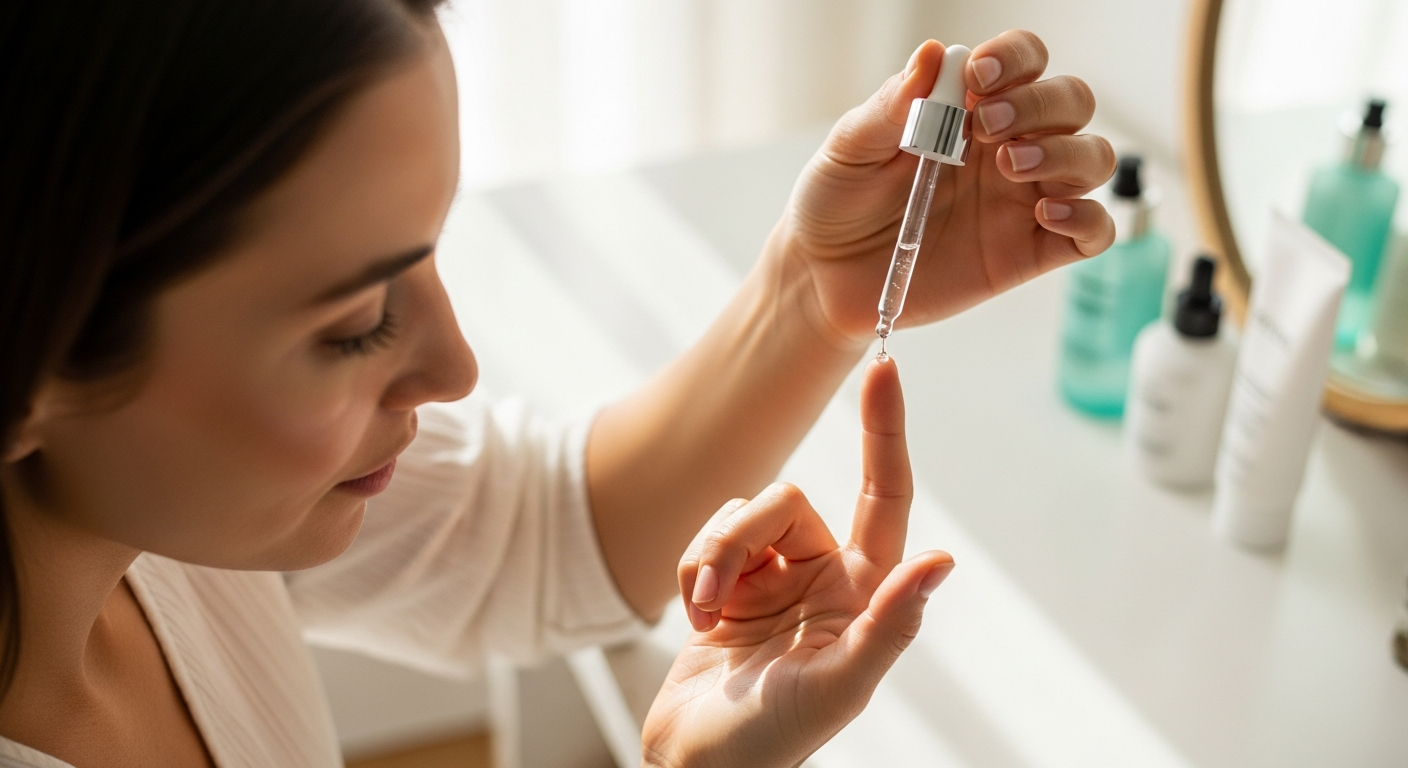

Retinol works by speeding up cell turnover and signaling your skin to produce more collagen, which is why dermatologists still call it the most proven anti-aging ingredient available without a prescription. If you use it wrong, though, you get the redness, flaking, and stinging that make most women quit within two weeks. Get the ramp-up right, and you will see smoother texture by week 6 and real fine-line improvement by week 12.
This guide walks you through starting retinol as a true beginner: how much to use, how often, what to pair it with, what to avoid, and how to tell a normal “purge” from an actual reaction.
What Retinol Actually Does to Your Skin
Retinol is a vitamin A derivative that your skin converts into retinoic acid through two enzymatic steps once it’s absorbed. That conversion is why retinol is gentler and slower-acting than prescription tretinoin, which arrives at the skin cell already in its active form.
Once converted, retinoic acid binds to retinoic acid receptors in your skin cells. This speeds up the rate at which old, dull surface cells shed and new ones replace them, a process called cell turnover.
It also tells fibroblasts deeper in the dermis to make more collagen and elastin.
A widely cited clinical review by Mukherjee et al. (2006), published in Clinical Interventions in Aging, found that topical retinoids reduce the appearance of fine wrinkles and improve mottled pigmentation and texture. Many users report visible change starting around the 12-week mark of consistent use.
That 12-week mark matters. Most beginners judge retinol after 10 days and give up. Skin cell turnover cycles run 28 to 40 days on average, and collagen remodeling takes even longer, so early quitting is the single biggest reason people say “retinol didn’t work for me.”
Retinol vs Retinoids vs Tretinoin vs Retinaldehyde: The Strength Ladder
“Retinoid” is the umbrella term for every vitamin A derivative used in skincare. Retinol sits in the middle of the strength ladder, not at the bottom and not at the top.
- Retinyl esters (retinyl palmitate, retinyl acetate): weakest, gentlest, minimal irritation, minimal results. Good only for extremely reactive skin just starting out.
- Retinol: over-the-counter standard. Requires two conversion steps to become active. Effective but slower than prescription options.
- Retinaldehyde (retinal): one conversion step away from active retinoic acid, so it works faster than retinol at a similar irritation level. Brands like Avibes and La Roche-Posay Retinol B3 (which actually uses pure retinaldehyde despite the name) fall here.
- Tretinoin: prescription-only in the US. This is retinoic acid itself, no conversion needed. Fastest results, highest irritation risk. Brand names include Retin-A and Renova.
- Adapalene: prescription-strength retinoid (also sold OTC as Differin 0.1% in the US since 2016), originally developed for acne, now used off-label for texture and mild anti-aging.
If you’re brand new to retinoids, start with retinol, not retinaldehyde or tretinoin. Build tolerance for 8 to 12 weeks before considering a step up.
How to Start Retinol Without Wrecking Your Skin
The ramp-up schedule matters more than the product you buy. Even a $12 drugstore retinol works if you introduce it correctly, and a $90 serum will irritate you just as badly if you rush it.
Week 1-2: Twice a week, pea-size amount
Apply a pea-size amount (roughly a quarter-teaspoon covers your whole face) to completely dry skin, at night, two non-consecutive nights per week. Skin must be dry. Retinol penetrates faster into damp skin, which increases irritation without adding benefit.
Week 3-4: Every other night
If your skin tolerated weeks 1 and 2 with no more than mild, temporary flaking, move to every other night. Some women feel tightness or slight sensitivity around day 10 to 14. That’s typically normal adjustment, not damage.
Week 5-8: Nightly, if tolerated
Progress to nightly use only if you have no persistent redness, burning, or peeling that lasts more than a day. Many women, especially those over 35 with drier skin, never need to go past every-other-night, and that’s fine. Consistency at a lower frequency beats nightly use you can’t sustain.
The Buffering (Sandwich) Method for Sensitive Skin
If your skin is reactive, rosacea-prone, or you’ve reacted badly to actives before, use the sandwich method: apply a plain moisturizer first, wait 10 minutes, apply your retinol, then apply another layer of moisturizer on top. This dilutes contact concentration and cuts irritation significantly without meaningfully reducing efficacy, a technique dermatologists commonly recommend for exactly this reason.
Women managing broader skin sensitivity through the seasons should also look at how their winter skin routine already handles barrier repair, since a compromised barrier from cold, dry air makes retinol irritation worse, not better.
Retinol Purge vs Real Breakout: How to Tell the Difference
A retinol purge happens because faster cell turnover pushes existing microcomedones (the invisible clogs already forming under your skin) to the surface faster than they would have on their own. It typically appears in the first 2 to 6 weeks, concentrates in areas you already break out (usually the chin, jawline, or forehead), and resolves on its own within 4 to 6 weeks without new products.
A real reaction or breakout looks different: it shows up in new areas you don’t normally get acne, comes with burning or stinging rather than just visible bumps, and gets worse the longer you continue rather than improving.
| Signal | Retinol Purge | Real Reaction |
|---|---|---|
| Location | Usual breakout zones | New, unusual areas |
| Timeline | Improves by week 4-6 | Worsens with continued use |
| Sensation | Mild dryness, no burning | Burning, stinging, swelling |
| Action | Continue current frequency | Stop and reduce frequency |
If you’re dealing with textural bumps under the skin rather than active breakouts, it helps to know the difference between clogged pores and normal skin structure. If you also shave your face or body regularly, read up on how to keep your skin safe while shaving at home before adding more actives on top, since freshly shaved skin absorbs retinol faster and irritates more easily.
What to Pair With Retinol and What to Avoid on the Same Night
Retinol plays well with some ingredients and actively fights others. Getting this wrong is the second most common reason women think they’re “allergic” to retinol when they’re actually just stacking too many actives.
Safe to pair
- Hyaluronic acid: hydrates without buffering the retinol’s effect. Apply before retinol on damp skin, or after if your skin runs dry.
- Niacinamide: reduces redness and supports barrier function. Can be layered same night, before or after retinol, with no loss of efficacy.
- Peptides: generally compatible, no significant interaction data suggesting conflict.
Avoid on the same night
- Vitamin C (L-ascorbic acid): works best in a low pH environment, while retinol prefers neutral pH. Mixing them same-night can destabilize both and increase irritation. Use vitamin C in the morning, retinol at night.
- AHA/BHA exfoliants (glycolic acid, salicylic acid): stacking two exfoliating mechanisms on the same night multiplies irritation risk without multiplying benefit. Alternate nights instead: retinol on Monday/Wednesday/Friday, acids on Tuesday/Thursday, for example.
- Benzoyl peroxide: oxidizes and degrades retinol, reducing its effectiveness, and the combined drying effect is brutal on a beginner’s skin barrier. If you use benzoyl peroxide for acne, apply it in the morning and retinol at night, never together.
If your routine already includes exfoliating acids as part of managing bumps or texture, this is where a lot of women overcomplicate things. Simplify first. Add retinol alone for 4 weeks before reintroducing acids on alternating nights.
SPF Is Not Optional With Retinol
Retinol increases how easily your skin cell turnover happens, and newer skin cells at the surface are more vulnerable to UV damage until they’ve matured. Multiple dermatology sources, including guidance summarized by the American Academy of Dermatology, note that retinoid users need consistent daily SPF because skipping it accelerates sun damage and can undo the benefits you’re working for.
This isn’t a “wear it if you remember” instruction. Broad-spectrum SPF 30 or higher, every single morning, rain or shine, is the non-negotiable second half of any retinol routine. Skipping SPF while using retinol is functionally paying to age your skin faster while thinking you’re doing the opposite.
If your day routine needs a full rebuild around this, protecting your skin during high-UV months covers the SPF layering details that pair directly with a retinol regimen.
How Sensitive Skin Should Approach Retinol
If you have rosacea, eczema, or a history of reacting to actives, don’t skip straight to nightly retinol just because a friend tolerates it that way.
Start with the retinyl ester tier or a low-percentage retinol (0.01% to 0.03%), buffer with moisturizer using the sandwich method, and stretch the ramp-up to once weekly for the first month.
Patch test on your inner forearm for 48 hours before applying anything new to your face. This single step catches most bad reactions before they happen on visible skin.
Skin barrier health outside of actives matters just as much here. If you’re already managing seasonal dryness or reactive skin, look at your makeup routine’s compatibility with sensitized skin, since heavy, occlusive makeup over freshly retinized skin can trap irritation underneath.
Pregnancy and Breastfeeding: Avoid Retinoids Entirely
Topical retinoids, including retinol, are not recommended during pregnancy or breastfeeding. Medical guidance, including positions summarized by the American College of Obstetricians and Gynecologists, advises against retinoid use in pregnancy.
This is a precaution linked to associations between high-dose oral vitamin A derivatives and birth defects. Topical absorption is far lower than oral, but the standard clinical guidance is to avoid the entire retinoid category during pregnancy and breastfeeding.
If you’re pregnant, trying to conceive, or breastfeeding, switch to pregnancy-safe alternatives like bakuchiol, which mimics some retinol effects on collagen without the vitamin A mechanism. Vitamin C and peptides are also fine to continue.
Talk to your OB or dermatologist before restarting retinoids postpartum, especially while breastfeeding.
Realistic Timeline: What to Expect Week by Week
Week 1 to 2 usually brings mild dryness or a handful of small flaky patches around the nose and mouth, nothing dramatic if you’re using a pea-size amount.
Week 3 to 4 is when many women notice a temporary purge along the jawline or chin, which resolves on its own.
By week 6 to 8, skin texture starts feeling noticeably smoother under your fingers, even before you see visible change in the mirror.
Week 10 to 12 is typically when fine lines around the eyes and mouth start softening and overall tone evens out, matching the 12-week window many users report in that timeframe.
Full collagen remodeling benefits continue building for 6 months or longer with consistent use. This is a maintenance ingredient, not a one-time fix. Stop using it and the turnover rate returns to baseline within a few weeks.
Frequently Asked Questions
How long does it take to see results from retinol?
Most people notice smoother texture by week 6 to 8 and visible fine-line improvement by week 12, based on consistent nightly or every-other-night use. Full collagen benefits continue building for 6 months or more.
Can I use retinol every night as a beginner?
No. Start twice weekly for 2 weeks, move to every other night for weeks 3 to 4, then progress to nightly only if your skin shows no persistent redness or peeling. Rushing this causes most beginner reactions.
Should I apply retinol before or after moisturizer?
Apply retinol to completely dry skin first, then moisturizer after. If your skin is sensitive, use the sandwich method: moisturizer, wait 10 minutes, retinol, then moisturizer again on top.
Can I use vitamin C and retinol in the same routine?
Yes, but not in the same application. Use vitamin C in the morning under SPF, and apply retinol at night. Mixing them same-night can destabilize both ingredients and increase irritation.
Is retinol safe during pregnancy?
No. Retinoids, including over-the-counter retinol, are not recommended during pregnancy or breastfeeding per ACOG guidance. Switch to bakuchiol or pause actives entirely until cleared by your doctor.
What’s the difference between retinol and tretinoin?
Retinol requires two enzymatic conversion steps in the skin to become active retinoic acid, making it slower and gentler. Tretinoin is retinoic acid itself, prescription-only, faster-acting, and more irritating for beginners.
Why does my skin break out when I start retinol?
This is usually a purge, caused by faster cell turnover pushing existing clogs to the surface sooner. It typically appears in your usual breakout zones within the first 2 to 6 weeks and resolves without changing products.
Do I really need sunscreen every day with retinol?
Yes, without exception. Retinol increases the rate of skin cell turnover, leaving newer surface cells more vulnerable to UV damage. Skipping daily broad-spectrum SPF 30+ undermines the anti-aging benefit you’re trying to build.