
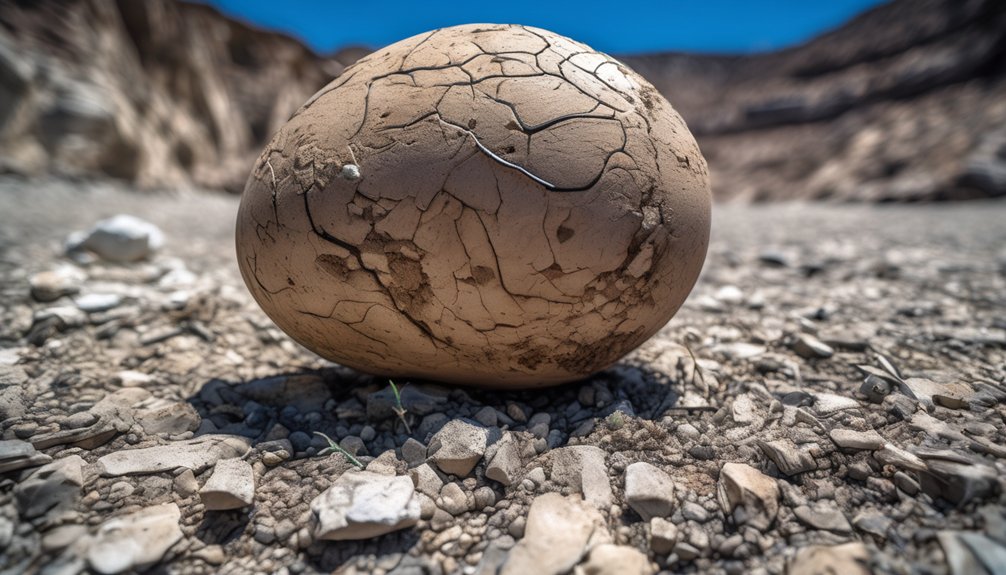

When a dinosaur egg was found in China, scientists confirmed its age through geological analysis and identified its species by examining the egg’s shape, size, and shell structure. They learned about dinosaur nesting behaviors and advanced reproductive strategies, such as parental care. Preservation details showed rapid burial and mineral-rich sediment protected the egg, aiding fossilization. This discovery enhances paleontological methods and fills gaps in reproduction knowledge. Further insights reveal more about both ancient ecosystems and fossil preservation.
Discovery Location and Initial Examination
The dinosaur egg was discovered at a well-known fossil site in China’s Henan Province, an area recognized for its rich deposits of prehistoric remains.
When you explore this site, you’ll notice that careful excavation techniques are essential to preserve delicate fossils. Experts use precise tools and methods to avoid damaging the egg during extraction.
Understanding the geological context is equally important, as it helps you determine the egg’s age and the environment in which the dinosaur lived. This context includes studying surrounding rock layers and sediment composition, providing valuable insights before further analysis begins.
Species Identification and Classification
After carefully extracting the egg and studying its geological context, researchers focus on identifying the species it belongs to. They analyze species morphology by comparing the egg’s shape, size, and shell texture with known dinosaur eggs.
Next, they examine microscopic features to confirm its evolutionary significance within dinosaur lineage. Finally, they use phylogenetic analysis to classify the species accurately. This process allows you to understand how this discovery fits into the broader dinosaur family tree, revealing important links between ancient species and their development over time.
Such identification enriches your knowledge of prehistoric biodiversity and evolution.
Insights Into Dinosaur Reproductive Behavior
While studying this dinosaur egg, you gain valuable insights into reproductive behaviors that shaped ancient species.
The egg reveals specific nesting habits, suggesting dinosaurs carefully selected and prepared sites to protect their offspring. These behaviors indicate advanced reproductive strategies, including possible parental care to increase hatchling survival rates.
Preservation Conditions and Fossilization Process
Understanding the conditions that allowed this dinosaur egg to remain intact over millions of years helps you appreciate the fossilization process.
Fossil preservation depends heavily on sedimentary processes that protect organic material from decay. Here’s what matters most:
- Rapid burial: The egg was quickly covered by sediment, shielding it from scavengers and oxygen exposure.
- Mineral-rich environment: Minerals infiltrated the eggshell, replacing organic material and hardening it.
- Stable conditions: Low pressure and temperature fluctuations prevented damage during fossilization.
Implications for Paleontological Research
Because this dinosaur egg offers a rare glimpse into prehistoric life, it provides valuable insights for paleontological research.
You can refine paleontological methods by studying its structure and composition, improving techniques for analyzing similar finds. This discovery helps fill gaps in the fossil record, offering clearer data on dinosaur reproduction and development.
As you examine this egg, you’ll better understand environmental conditions that influenced fossilization. Applying these insights, you can enhance excavation strategies and data interpretation, contributing to more accurate reconstructions of ancient ecosystems.
Ultimately, this find supports ongoing efforts to deepen our knowledge of prehistoric life.
Frequently Asked Questions
How Big Was the Dinosaur That Laid the Egg?
You’ll find the dinosaur size was likely massive, inferred from the egg characteristics like its large shell and shape. These clues let you imagine how free and wild this giant creature must’ve been roaming ancient lands.
Were Any Embryos Found Inside the Egg?
Yes, scientists found embryos inside the egg. Through detailed fossil analysis, they tracked embryo development stages, giving you a rare glimpse into ancient life, revealing secrets that let your curiosity roam free and explore prehistoric mysteries.
How Old Is the Dinosaur Egg?
The dinosaur egg’s around 70 million years old, thanks to fossil dating and paleontological methods. You can trust these techniques—they reveal Earth’s history, letting you explore ancient life freely and truly understand our planet’s past.
Can the Egg Provide DNA for Cloning?
You can’t rely on this egg for cloning possibilities since DNA degrades over millions of years. However, genetic analysis still offers insights into dinosaur evolution, giving you freedom to explore prehistoric life without actual cloning.
What Tools Did Scientists Use to Study the Egg?
You’ll find that scientists used microscopic analysis and advanced imaging techniques to study the egg. These tools let them explore its structure without damaging it, giving you a clear, detailed glimpse into prehistoric life.