
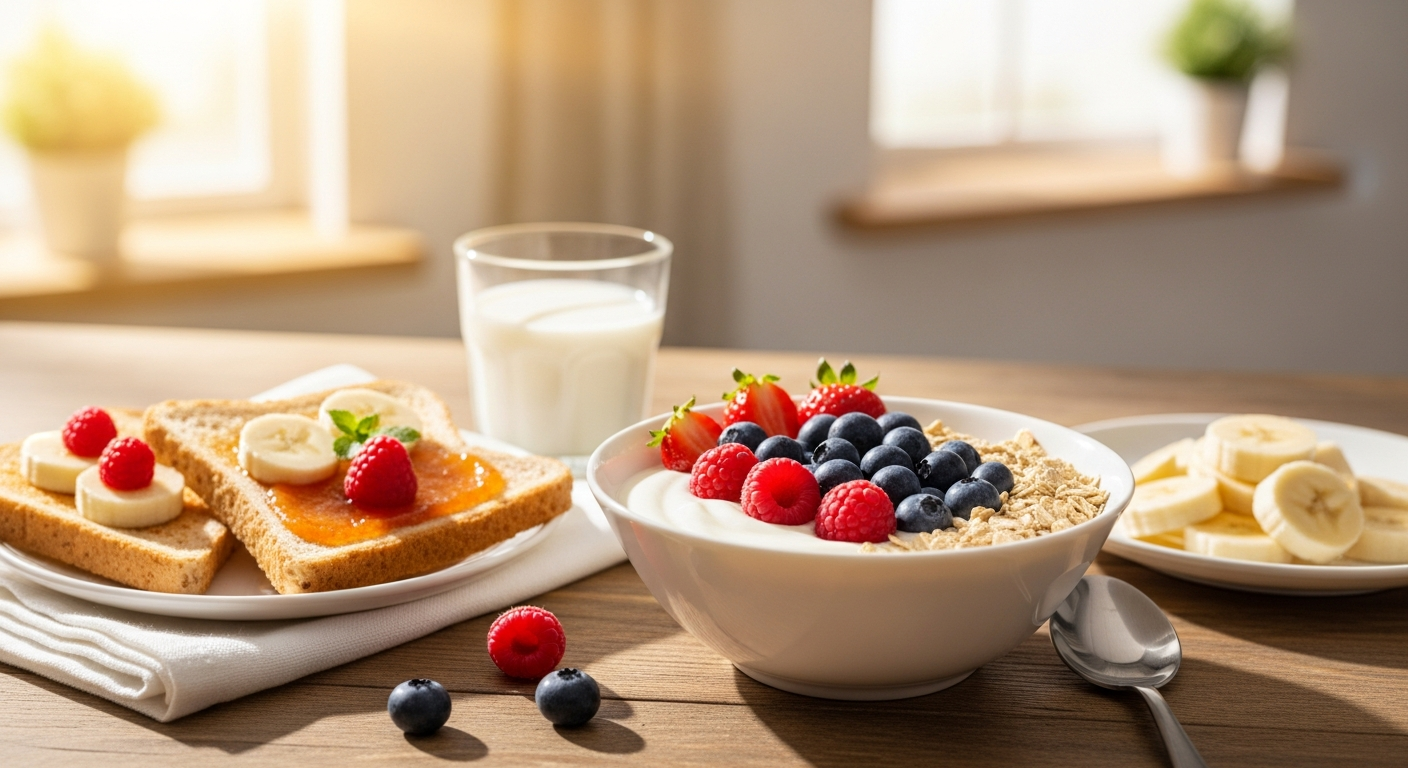

A healthy breakfast for kids means protein, fiber, and a piece of fruit inside 15 minutes of waking up, not a bowl of sugar-dusted cereal that leaves them starving by 9 a.m.
That gap between “fed” and “actually fueled” is where most school mornings fall apart. Get the combination right and you get a kid who can sit through a math lesson without meltdown or midmorning crash.
You already know breakfast matters. What you need is what actually works when you have eleven minutes, one kid who says she’s “not hungry,” another who only eats beige food, and a backpack that still needs a signature.
This guide gives you the real options, not the Pinterest fantasy, grounded in the same protein-fiber-fruit framework pediatricians and registered dietitians recommend, not a fad.
Why Kids’ Breakfast Actually Affects Focus and Mood
Kids who eat breakfast show better attention, memory, and classroom behavior than kids who skip it, according to research summarized by the Academy of Nutrition and Dietetics.
The effect is strongest in kids who are already at nutritional risk, meaning the payoff is biggest for exactly the kids most likely to skip.
The American Academy of Pediatrics makes the same point on HealthyChildren.org: kids who eat breakfast tend to concentrate better and have more stable energy through the morning than kids who go without.
The mechanism is simple. A child’s brain runs almost entirely on glucose. After 10-12 hours without food overnight, blood sugar is low.
Feed a kid straight starch and sugar with nothing to slow it down, and you get a spike, then a crash around 10 a.m. That crash looks a lot like a discipline problem but is actually a fuel problem.
Protein and fiber slow that glucose release. That’s the entire science behind “balanced breakfast” advice. It’s not about eating clean or virtuous food. It’s about digestion speed.
What a Balanced Kid Breakfast Actually Looks Like
Three components, every morning, in any combination: a protein source, a fiber source, and something with natural sugar like fruit. That’s the whole formula. You don’t need a nutritionist’s chart on the fridge.
This lines up with what registered dietitians at the Academy of Nutrition and Dietetics tell parents on eatright.org: a breakfast built around protein and fiber keeps kids fuller and steadier than one built around refined carbs alone.
- Protein: eggs, Greek yogurt, milk, peanut butter, cheese, turkey sausage
- Fiber: whole grain toast, oatmeal, whole grain waffles, a banana
- Fruit or natural sugar: berries, apple slices, orange segments, a smoothie
You do not need to ban sugary cereal outright. A bowl of sweetened cereal with milk and a handful of berries on the side is a completely fine Tuesday breakfast.
The problem is cereal alone, with nothing slowing the sugar down, five days a week. Pair it with protein or fruit and the whole nutritional profile changes.
Reading the nutrition label helps more than reading the front of the box. Look for cereals with 3+ grams of fiber and under 10 grams of added sugar per serving.
Most “kid” cereals fail that test, which is fine occasionally, just not as the daily default.
The USDA’s Dietary Guidelines for Americans put a number on this: added sugar should stay under 10% of a child’s daily calories. A single sugary cereal serving can eat up a big chunk of that budget before 8 a.m., which is the real argument for pairing it with protein and fruit rather than banning it outright.
5-Minute Breakfasts for School Mornings
These are the ones that survive an actual weekday, tested against a house with three kids on three different schedules.
- Greek yogurt parfait: plain Greek yogurt, a spoon of honey, granola, berries. Two minutes if the yogurt is already in single-serve cups.
- Peanut butter banana toast: whole grain toast, peanut butter, banana slices. Ninety seconds, and it travels well in foil if the bus is already at the corner.
- Scrambled eggs, microwave version: crack two eggs in a mug, splash of milk, whisk, microwave 45 seconds, stir, another 30 seconds. Ninety seconds total, tastes better than it sounds.
- Cheese quesadilla: shredded cheese folded into a tortilla, 30 seconds in the microwave or a minute in a dry pan. Kids who refuse eggs will often eat this.
- Cottage cheese and fruit cup: zero prep if you buy the fruit cups packed in juice, not syrup.
- Apple slices with peanut butter: slice one apple, pack a small container of peanut butter for dipping. No cooking, no dishes beyond the container lid.
Make-Ahead Breakfasts That Actually Survive the Fridge
Overnight oats are the internet’s favorite answer, and they deserve the reputation, but only if you get the ratio right. Too much liquid and you get soup by morning.
The reliable ratio is 1/2 cup rolled oats to 1/2 cup milk plus 2-3 tablespoons yogurt, refrigerated in a mason jar for at least 6 hours. That holds texture for up to four days without turning to mush.
Egg muffins are the other one worth the Sunday effort. Whisk 8 eggs, pour into a greased muffin tin with chopped spinach, cheese, and diced ham, bake at 350°F for 18-20 minutes.
They reheat in 30 seconds and freeze for up to two months. Twelve muffins covers most of a school week for one kid, less for a family of three who all like them.
Breakfast burritos freeze the same way. Scrambled eggs, cheese, black beans, wrapped tight in foil, frozen flat. Microwave from frozen for 90 seconds, flip, another 60 seconds. The foil keeps them from drying out, which is the actual failure point of frozen burritos.
What doesn’t survive the fridge well: pancakes made with fruit mixed into the batter (they get gummy by day two), and anything with fresh-cut avocado (browns within hours regardless of lemon juice tricks).
Grab-and-Go and No-Cook Options
Some mornings there is no stove time available, period. These require zero cooking and zero cleanup beyond a spoon.
- String cheese, a piece of fruit, and a handful of whole grain crackers
- A smoothie blended the night before and stored in the fridge, shaken before drinking (blend in the morning if you have a quiet blender and 90 seconds)
- Hummus and baby carrots with pita
- A hard-boiled egg made in a batch on Sunday, peeled and stored in the fridge
Hard-boiled eggs are the most underrated item on this list. A dozen boiled on Sunday keeps for a week and needs zero morning effort beyond grabbing one from the fridge.
What to Do When Your Kid Says They’re “Not Hungry”
This is real, not an excuse, especially in kids under 10. Appetite in the first hour after waking is genuinely lower for some children, and forcing a full plate at 7 a.m. usually backfires into a fight nobody wins.
The fix isn’t more food. It’s smaller portions and a longer window. Send a piece of fruit and a cheese stick in the backpack for the car or the first ten minutes at school, rather than demanding a full breakfast at the table.
Many elementary schools run a grab-and-go breakfast program specifically because this pattern is common. Ask the front office if yours does.
A smoothie also solves the “not hungry” problem better than solid food, since kids who can’t face chewing at 7 a.m. will often still drink something. Blend milk, a banana, a spoon of peanut butter, and a handful of spinach they will never taste.
Options for Picky Eaters
Picky eating and low morning appetite often overlap, which makes mornings feel like a negotiation. The move that works more often than any menu change is repetition without pressure.
Offering the same three “safe” breakfast items on rotation, rather than pushing variety at 7 a.m., reduces the daily standoff.
Beige-food kids, the ones who live on toast, plain pasta, and crackers, usually still accept plain yogurt, string cheese, and buttered toast with a banana on the side.
That combination hits the protein-fiber-fruit formula without asking a picky kid to try anything new before school.
Hiding vegetables in a smoothie works better than hiding them in eggs, because the texture disappears completely in a blender. A handful of spinach in a berry smoothie is invisible in taste and color once the berries dominate.
Budget-Friendly Healthy Breakfasts
Eggs remain the cheapest complete protein on the market, running roughly 20-25 cents per egg depending on region and season. A dozen eggs feeds a family of four breakfast for nearly a week when paired with toast.
Oats bought in bulk canisters cost a fraction of individual instant packets and work identically in overnight oats or hot cereal.
Frozen fruit, not fresh, is the budget move for smoothies and yogurt bowls. It’s often cheaper than fresh and just as nutritious, since it’s flash-frozen at peak ripeness.
Store-brand plain yogurt with your own honey and fruit mixed in costs less than half of pre-flavored single-serve cups, and you control the sugar content. Peanut butter toast remains one of the cheapest protein-plus-fiber combinations available, at well under a dollar per serving.
Building a Repeatable Weekly Rotation
The families who stop fighting about breakfast are the ones who stop reinventing it daily. Pick five to seven options from this list, write them on an index card taped inside the pantry door, and rotate them.
Kids do better with predictable choices than with novelty every morning, and you do better with a decision already made before 6:45 a.m.
A workable Monday-through-Friday rotation might look like: overnight oats, egg muffins from the freezer, yogurt parfait, peanut butter toast, and a smoothie on the day everyone’s running latest.
That’s five meals prepped once a week, mostly on Sunday, with almost no daily decision left to make.
Getting kids involved in fruit and vegetable prep on weekends also raises the odds they’ll actually eat what’s in the bowl come Monday.
Kids who help wash and cut their own fruit snacks are more likely to eat them without a fight, a pattern covered in more detail in how to wash and prepare fruits and veggie snacks for your kids.
The same logic applies to breakfast fruit: pre-washed and pre-cut on Sunday means it actually gets eaten on Wednesday.
If getting kids to eat any fruit or vegetable feels like the bigger battle than breakfast itself, this is how to get your kids to eat fruits and veggies covers strategies that work alongside the ideas here.
And if cholesterol or heart health is a family concern rather than just a school-morning logistics problem, five healthy breakfast foods to lower cholesterol narrows the list further toward oats, and specific fiber sources that double as kid-friendly options.
FAQ: Healthy Breakfast for Kids
What is the healthiest quick breakfast for kids?
Greek yogurt with berries and a drizzle of honey covers protein, fiber, and fruit in under two minutes with zero cooking. It’s the fastest option that still hits all three components of a balanced kid breakfast.
Is cereal ever okay for a kid’s breakfast?
Yes, as long as it’s not the only thing in the bowl. Pair sweetened cereal with milk and fresh fruit, or choose a version with 3+ grams of fiber and under 10 grams of added sugar, so blood sugar doesn’t spike and crash by mid-morning.
What can I make the night before for a busy school morning?
Overnight oats, egg muffins baked in batches, and pre-portioned smoothie freezer packs all hold up for several days in the fridge or weeks in the freezer, and need under a minute of morning effort.
My kid says they’re not hungry in the morning. Should I make them eat?
Forcing food usually backfires. Offer a smaller portion, like a piece of fruit and a cheese stick to eat in the car or at school, or try a smoothie, since low morning appetite in kids is common and drinking is often easier than chewing.
What’s a good breakfast for a picky eater who only likes plain food?
Plain yogurt, buttered toast, and string cheese hit the protein-fiber combination without requiring a picky kid to try anything unfamiliar. Add a banana on the side rather than mixing fruit into the main food.
What’s the cheapest way to feed kids a healthy breakfast every day?
Eggs, bulk oats, and frozen fruit are the three lowest-cost staples that still deliver protein, fiber, and vitamins, generally running well under a dollar per serving when bought in bulk rather than pre-packaged.