
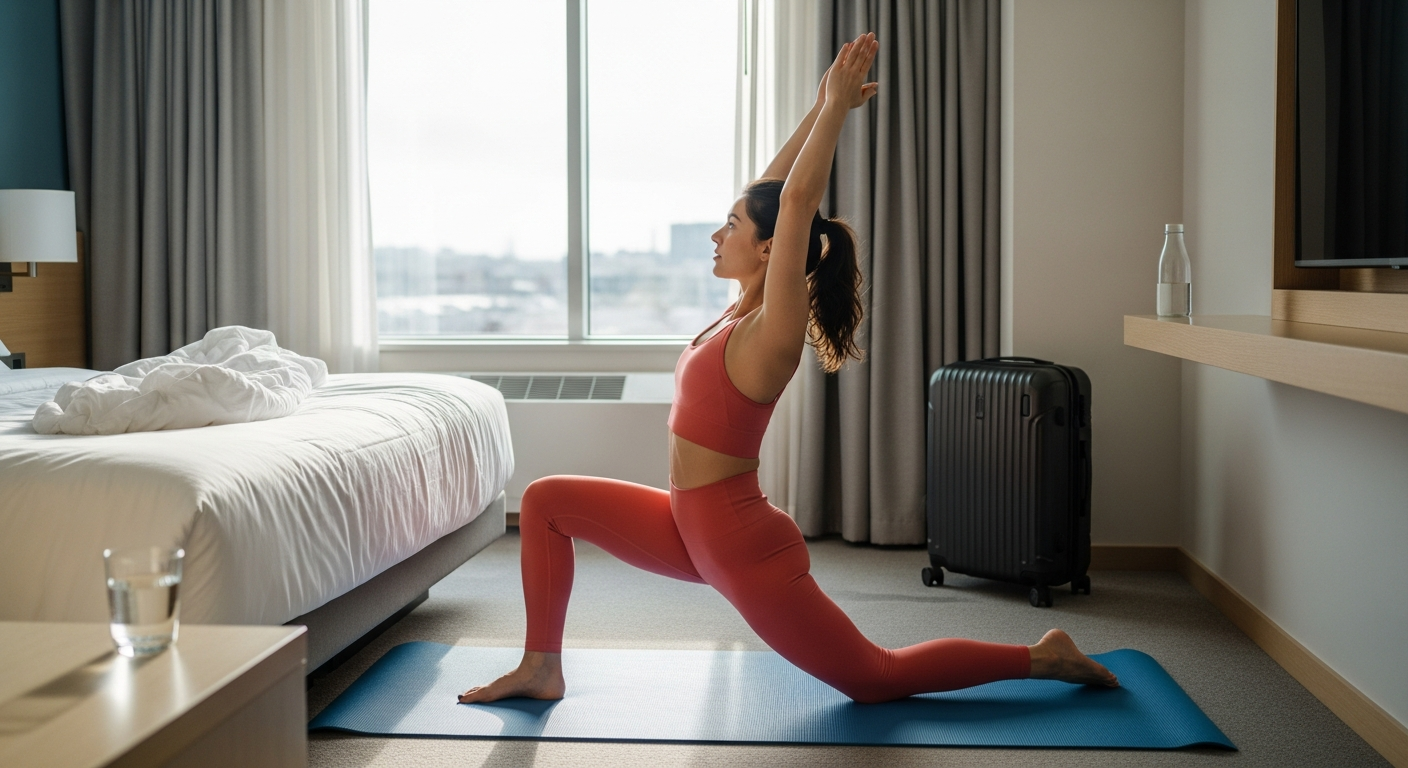

Staying fit while traveling means keeping your body moving and your habits intact, not chasing a personal record from your hotel room. The goal is maintenance, not progress. Give yourself that permission and the whole trip gets easier.
Most women don’t fall off track because they lack willpower. They fall off track because they packed no plan and expected motivation to show up at 6 a.m. in a strange city.
Traveling in cold months brings its own challenges; these wintertime fitness tips and a winter workout routine work whether you’re home or away.
Motivation doesn’t travel well. Systems do.
By the end of this guide you’ll have a realistic hotel-room routine, a packing list that actually fits in a carry-on, and specific strategies for flights, jet lag, restaurant meals, and the days when nothing goes as scheduled.
Why “Maintain, Don’t Peak” Is the Right Mindset for Travel
Travel disrupts your normal training volume, sleep, and food access all at once. Trying to hit personal bests during that disruption sets you up to feel like a failure by day three. Aim to preserve 60 to 70 percent of your usual activity level instead.
That number comes from how coaches program deload weeks. A short break from peak training doesn’t erase fitness gains. Muscle strength and cardiovascular capacity built over months don’t disappear after one or two weeks of lighter movement.
Research on detraining shows measurable declines in VO2 max typically start after roughly two weeks of complete inactivity, not after a few lighter sessions. A five-day work trip with three 20-minute hotel workouts keeps you well inside the safe zone.
Reframe the trip as active recovery. You’re not losing progress. You’re banking consistency, which is the metric that actually predicts long-term results.
Strength training tells the same story. A 2022 review in Sports Medicine found trained lifters retain most of their strength for up to three weeks with zero training, since neural adaptations fade slower than people assume.
How Do You Plan Fitness Around a Trip Before You Even Pack?
Check your hotel’s gym photos on Google before you arrive. Pack a backup plan in case the “fitness center” turns out to be two treadmills and a broken rowing machine. This takes five minutes and saves an entire trip’s worth of frustration.
Search the hotel name plus “gym” in Google Images. Chain hotels like Marriott and Hilton usually have decent equipment. Boutique hotels and short-term rentals are a coin flip, so plan a bodyweight backup regardless.
Block 20 to 30 minutes on your calendar for movement, the same way you’d block a client call. Morning slots survive schedule chaos better than evening ones, because dinners and meetings tend to eat into evening time first.
If you’re traveling for a wedding, conference, or family visit, tell one person your plan out loud. Saying “I’m doing a quick workout before breakfast” to a travel companion helps.
Accountability research from the American Society of Training and Development shows this simple step roughly doubles your odds of following through.
What Actually Fits in a Carry-On for Workouts
A resistance band set, one skipping rope, and running or walking shoes cover almost every travel workout scenario, and together they weigh under two pounds. That’s the entire equipment list. Nothing else is required.
Here’s the exact packing list that has worked for years of carry-on-only trips:
- A set of 3 to 5 loop resistance bands (light, medium, heavy). Rolls into a sock, takes up less room than a phone charger
- One speed rope, the kind with a cloth or PVC cord, not the heavy leather gym version
- Compact walking or running shoes you’d actually wear outside the gym, so they don’t take a separate slot in your bag
- A microfiber travel towel that packs down to the size of a fist
Skip the yoga mat unless you’re driving. Most hotel room carpets or bathroom tile work fine for floor exercises, and a folded towel handles the rest.
Leave dumbbells at home. Resistance bands replicate rows, presses, and squats with adjustable tension, and TSA has never once flagged a loop band at security.
A Hotel-Room Workout You Can Actually Do in 20 Minutes
A full-body bodyweight circuit of squats, push-ups, reverse lunges, plank holds, and glute bridges, done as three rounds with minimal rest, delivers a real training stimulus in about 20 minutes with zero equipment. This is the exact structure to use.
Round structure, three total rounds, 45 seconds work and 15 seconds rest per move:
- Bodyweight squats, 45 seconds
- Push-ups (knee or full), 45 seconds
- Reverse lunges, alternating legs, 45 seconds
- Plank hold, 45 seconds
Close the round with glute bridges, another 45 seconds, then take your 15-second rest and start the next round.
Three rounds of that circuit takes 18 minutes including rest. Add the resistance band for rows and lateral walks if you have one, and you’ve turned a hotel room into a functional gym.
This exact circuit has run in more hotel rooms than any equipment-based routine, because it requires nothing except floor space the size of a yoga mat. It works in a 200-square-foot city room just as well as a suite.
How Many Steps Should You Aim for While Traveling?
Aim for your normal daily step count, or close to it. Walking is the easiest movement to maintain on the road, and it often increases naturally during sightseeing or layovers. Most adults land between 5,000 and 10,000 steps on a travel day without trying.
A 2023 study published in JAMA Internal Medicine tracking over 2,000 adults found mortality risk dropped significantly up to about 7,500 steps per day, after which benefits leveled off. You don’t need 15,000. You need consistency.
Turn errands into walks. Walk to a coffee shop instead of ordering room service.
Take the stairs in a museum instead of the elevator. These add up faster than a scheduled “workout” because they don’t require a change of clothes.
Use your phone’s built-in step counter, no extra app required, and check it once at lunch and once before bed. That two-check habit keeps steps visible without turning your trip into a fitness-tracking obsession.
Staying Active on Long Flights and Road Trips
Move every 60 to 90 minutes on a flight or drive. Prolonged sitting slows circulation and raises deep vein thrombosis risk on trips over four hours, per CDC guidance. A short walk down the aisle or a rest-stop stretch handles most of that risk.
On planes, do ankle circles, seated marches, and calf raises at your seat every hour. Stand and walk to the galley or bathroom once per hour if you’re in a window or middle seat and it’s not disruptive to do so.
On road trips, stop every two hours minimum. Use the stop for a five-minute walk around the car, not just a bathroom break and back in the seat. Compression socks help on flights over five hours if you have a history of swelling.
Pack a resistance band in your personal item, not checked luggage, so a long layover becomes a 10-minute band workout in an empty gate area instead of dead time on your phone.
Eating on the Road Without Wrecking Your Week
Prioritize protein and produce at every meal you can control, treat one indulgent meal per day as the plan rather than a slip, and drink water before you drink alcohol or coffee. That’s the entire strategy, and it survives almost any travel schedule.
Airport strategy: skip the pretzel cart and look for a protein-forward option. A grain bowl, a grilled chicken salad, or a whole grain sandwich with vegetables all work. Most major US airports now carry at least one option with real protein beyond fried chicken.
Restaurant strategy: order a protein and a vegetable side before you look at bread or fries. Ask for dressing and sauce on the side.
This single swap cuts a meaningful amount of added sugar and fat, and you still get to enjoy the dish you’re excited about.
Hydration matters more while traveling than at home. Cabin air, heat, and alcohol all accelerate fluid loss. Carry an empty water bottle through security and fill it at the gate.
Aim for one glass of water for every alcoholic drink. It also happens to slow down how fast you order the next one.
Alcohol on trips isn’t the enemy, but it is the biggest single lever for how you’ll feel the next morning.
Two drinks with dinner rarely derails a trip. Five drinks plus a 6 a.m. flight will.
Sleep and Jet Lag: The Part Everyone Skips
Shift your sleep schedule 30 to 60 minutes toward your destination time zone for two or three nights before you fly. Get outside in daylight as soon as you land.
Light exposure resets your circadian rhythm faster than melatonin alone. It’s the single most effective jet lag strategy available without a prescription.
The Sleep Foundation notes it typically takes about one day per time zone crossed for your body to fully adjust. A trip from New York to Rome crosses six time zones, so expect roughly six days before you feel fully normal.
Most people function well by day three, though, so don’t assume the whole trip is a write-off.
Avoid caffeine within six hours of your new destination bedtime, even if your body thinks it’s 2 p.m. Melatonin, 0.5 to 3 mg, near the new local bedtime can help shift your clock faster. Check with your doctor first if you take other medications.
Poor sleep undoes more fitness progress than a missed workout ever will. One skipped gym session costs you almost nothing. Three nights of broken sleep tanks your energy, your cravings, and your motivation to move at all.
Safety Notes for Women Walking or Running in a New Place
Run or walk in daylight, choose routes with other pedestrians and good lighting, and share your live location with someone before you head out in an unfamiliar city. These three habits cut most of the risk without limiting where you can explore.
Use a running app with live tracking, Strava’s Beacon feature or Life360, and text a friend or your hotel front desk your rough route and expected return time. This takes 30 seconds and means someone notices if you don’t check in.
Ask your hotel concierge or front desk staff for a specific safe walking or running route. They know which streets get foot traffic at 6 a.m. and which ones don’t, and most hotels field this exact question daily.
Carry your phone, not just wear headphones connected to it. Keep volume low enough in one ear to hear your surroundings. This is a small adjustment that keeps you aware without giving up music or a podcast.
Cycle-Aware Training When You’re Away From Home
Match your workout intensity to where you are in your cycle instead of forcing the same intensity every day. Higher-intensity intervals and strength work tend to feel more manageable during the follicular phase.
The luteal phase often calls for steadier, lower-intensity movement, like walking or a gentler circuit.
If your trip lands during your period, don’t skip movement entirely. Light walking and stretching can ease cramping for many women, and a short bodyweight circuit at reduced intensity is a reasonable middle ground on days you don’t feel like doing nothing.
Pack period supplies in your carry-on regardless of how many days you expect to need them. Travel, time zone shifts, and stress can all shift cycle timing by a few days in either direction.
Track your cycle in whatever app you already use before the trip. That way you’re not guessing which phase you’ll be in on day four. It lets you plan the intense hotel workout for the right day instead of the wrong one.
Keeping the Habit When Your Routine Falls Apart Completely
When a trip goes sideways, whether it’s a canceled flight, a work emergency, or three days of nonstop meetings, drop your standard to five minutes of movement instead of zero. Stretching or a short walk keeps the habit alive when a full workout isn’t realistic.
Habit researchers call this “never miss twice.” One missed workout is a normal travel day. Two in a row starts to feel like the new pattern, and that’s when trips derail fitness routines long after you’re home.
Give yourself a floor, not a ceiling. The floor might be a 10-minute walk after dinner.
The ceiling is the full circuit from earlier in this guide. On a bad day, hit the floor and call it a win.
The goal isn’t a perfect trip. It’s a trip where you don’t come home starting from zero, which is a realistic target that survives delayed flights, time zone chaos, and hotel gyms that turn out to be a closet with a treadmill.
Building longer-term consistency once you’re back on solid ground makes the next trip easier before it even starts. Learning how to form an exercise habit that actually sticks is the place to start.
Pair that with smarter choices at the airport and grocery store. Knowing how to pick healthy snacks keeps hunger from derailing your food plan mid-layover.
Your daily eating patterns at home also set the tone for how you handle food on the road. Revisiting eating habits that support your weight loss goals gives you a framework you can adapt anywhere.
Jet lag recovery goes faster when your baseline sleep habits are solid. A quick refresh on sleep hygiene tips for women pays off both at home and three time zones away.
Frequently Asked Questions
How do you stay fit while traveling for work with a packed schedule?
Block 20 minutes in the morning before meetings start, since evening time gets consumed by dinners and unexpected work. A bodyweight circuit or a brisk walk covers the gap, and morning slots have the highest completion rate for business travelers.
Do you need gym equipment to stay in shape on a trip?
No. A bodyweight circuit of squats, push-ups, lunges, planks, and glute bridges builds real training stimulus without any equipment. A resistance band adds variety but isn’t required for a short trip.
How many rest days should you take while traveling?
Treat travel days themselves, especially flight days, as built-in rest. Aim for three to four movement sessions across a one-week trip rather than trying to match your usual five or six days at home.
What should you eat before a long flight to avoid bloating?
Choose a meal with lean protein and cooked vegetables rather than raw salads, carbonated drinks, or heavy sodium, since cabin pressure changes can worsen bloating. Eating two to three hours before boarding, not right before, also helps.
Is it safe to run alone in an unfamiliar city?
Running alone in daylight on a route with pedestrian traffic is reasonable for most cities, but share your route and expected return time with someone first. Ask hotel staff for a specific safe route rather than guessing from a map.
How long does it take to lose fitness after a week of travel?
Measurable declines in cardiovascular fitness typically don’t show up until roughly two weeks of near-total inactivity. A one-week trip with even light movement, walking and a couple of short workouts, keeps you well within a safe range.
What’s the best way to handle jet lag before an important event?
Shift your sleep schedule toward the destination time zone for two to three nights before departure, then get outside in daylight immediately after landing. This resets your circadian rhythm faster than trying to power through on the old schedule.