
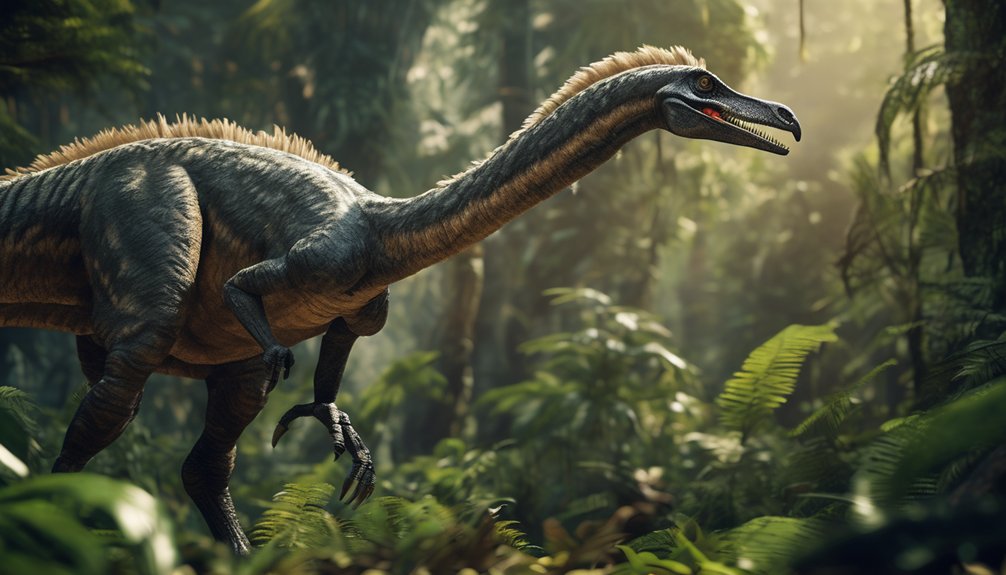

You’ll find Therizinosaurus notable for its remarkably long, curved claws over a meter in length, which it likely used to grasp and pull vegetation rather than for defense. This dinosaur inhabited forested areas, supporting a specialized herbivorous diet through unique feeding strategies involving its claws. Its unusual mix of features bridges gaps between carnivorous theropods and plant-eaters, revealing significant evolutionary insights. Exploring further uncovers more about its behavior, ecology, and anatomical adaptations.
Physical Characteristics and Claw Functionality
The Therizinosaurus is notable for its distinctive physical traits, especially its elongated claws, which can reach lengths of over one meter.
These claws exhibit unique claw morphology, featuring a curved, slender shape adapted for specific functions. You can see how their form suggests a role beyond mere defense—they likely played a key part in feeding strategies.
Instead of hunting, Therizinosaurus probably used its claws to grasp and pull vegetation, allowing it to access leaves and branches with ease.
Understanding these physical characteristics helps you appreciate how this dinosaur balanced strength and precision in its daily survival.
Habitat and Behavioral Adaptations
Although direct evidence about its environment is limited, Therizinosaurus likely inhabited forested regions with abundant vegetation, which supported its herbivorous diet.
You can imagine it using diverse feeding strategies, such as pulling leaves and branches with its giant claws. These adaptations allowed it to access food efficiently in dense foliage.
Regarding social behavior, evidence suggests Therizinosaurus might’ve been solitary or lived in small groups, minimizing competition for resources.
Understanding its habitat and behavior helps you appreciate how this dinosaur adapted to its surroundings, balancing survival needs with environmental opportunities in a dynamic ecosystem.
Evolutionary Importance and Fossil Discoveries
Since Therizinosaurus exhibits a unique combination of features not commonly seen in other theropods, it holds significant evolutionary importance.
You can explore how its unusual anatomy bridges gaps between carnivorous theropods and herbivorous dinosaurs, highlighting its evolutionary significance.
Fossil evidence, including well-preserved claws and partial skeletons, provides essential insights into this dinosaur’s lifestyle and development.
By studying these fossils, you better understand how Therizinosaurus adapted to its environment and diverged from typical theropod traits.
This evidence strengthens the evolutionary narrative, showing a distinct path within dinosaur evolution that challenges previous assumptions.
Frequently Asked Questions
How Was Therizinosaurus First Discovered and Named?
You’ll find the Therizinosaurus fossil discovery happened in the 1940s, but its strange claws puzzled scientists. Its naming history reflects that mystery, as it was named for those giant claws, highlighting its unique traits.
What Does the Name “Therizinosaurus” Mean?
You’ll find that the Therizinosaurus etymology means “scythe lizard,” inspired by its giant claws. Those claws symbolize freedom and power, letting you imagine a creature untamed and uniquely adapted to its world.
Did Therizinosaurus Live Alongside Other Famous Dinosaurs?
Yes, you’d find Therizinosaurus sharing its habitat with other famous dinosaurs. Its diet of plants let it roam freely, coexisting with predators and herbivores alike in a diverse, dynamic ecosystem.
What Size Were Therizinosaurus Eggs and Nests?
You’ll find Therizinosaurus eggs measured about 10-15 centimeters in length, showing they cared for their young with distinctive nesting behavior. Though exact nest sizes vary, they likely built secure sites to protect their offspring.
How Fast Could Therizinosaurus Move?
You won’t see Therizinosaurus sprinting fast; its speed capabilities were likely slow to moderate due to its massive size and unique movement patterns. It moved deliberately, embracing a steady pace that matched its powerful, clawed lifestyle.