
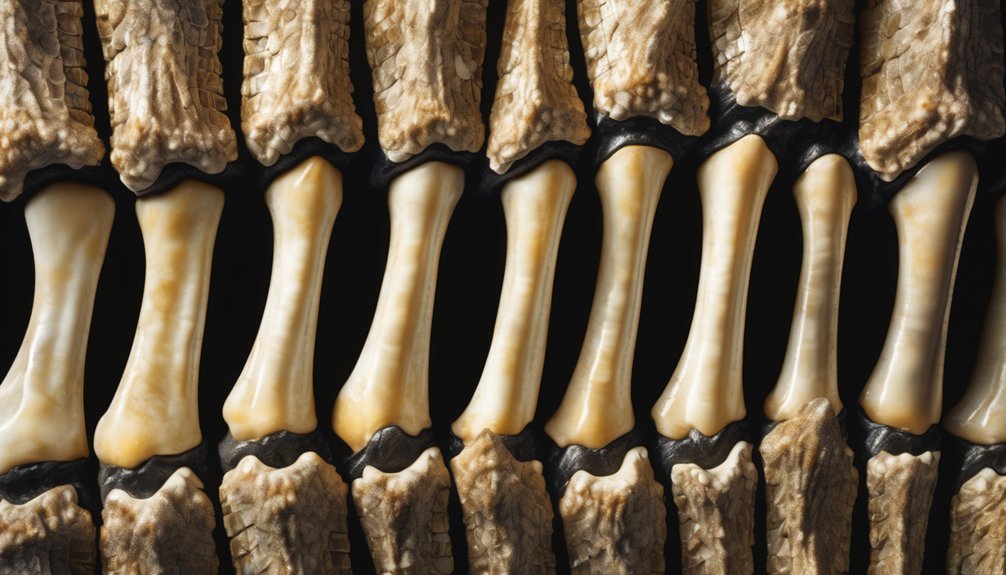

You’re looking at the Nigersaurus, a dinosaur from North Africa’s middle Cretaceous period, known for having about 500 teeth. These teeth were arranged in multiple rows and replaced continuously to stay sharp. Its broad, flat teeth helped it graze on low-lying plants like ferns and horsetails. Fossils have revealed this unique dental structure and feeding style, offering valuable insights. Exploring further will enhance your understanding of its anatomy and ecological role.
The Dinosaur With 500 Teeth: Identification and Overview
One dinosaur stands out for its extraordinary dental count, boasting approximately 500 teeth, which is far more than any other known species.
For your dinosaur identification, this prehistoric giant is identified as Nigersaurus, a herbivorous dinosaur that lived during the middle Cretaceous period.
When you explore its prehistoric overview, you’ll find Nigersaurus inhabited what’s now North Africa.
It had a wide mouth filled with rows of small, replaceable teeth adapted for grazing.
Understanding this creature enriches your knowledge of dinosaur diversity and evolutionary specialization, highlighting unique adaptations that contributed to its survival millions of years ago.
Anatomy and Function of Its Teeth
Nigersaurus had approximately 500 teeth arranged in multiple rows along its wide jaws, which worked together to efficiently process plant material. This unique tooth structure represents a remarkable evolutionary adaptation.
You’ll notice three key features:
- Continuous tooth replacement, ensuring sharpness without interruption.
- Broad, flat teeth ideal for cropping vegetation.
- Multiple rows lined up to maximize grinding surface.
These adaptations allowed Nigersaurus to maintain an effective dental system suited for its environment.
Understanding this anatomy helps you appreciate how evolution shaped its teeth for specialized function, highlighting nature’s precision in meeting survival needs.
Diet and Feeding Habits
The specialized teeth of Nigersaurus played a significant role in shaping its diet and feeding habits.
You’ll find that this dinosaur’s herbivorous diet relied on its hundreds of small, replaceable teeth to efficiently graze low-lying vegetation. Its feeding behavior involved sweeping its broad, wide muzzle close to the ground, cropping soft plants like ferns and horsetails.
This continuous tooth replacement supported constant feeding without wear slowing it down. By understanding Nigersaurus’s dental adaptations, you gain insight into how its herbivorous diet influenced its unique feeding behavior, allowing it to thrive in environments rich with accessible plant life.
Fossil Discoveries and Scientific Significance
Although fossil remains of this dinosaur were initially scarce, significant discoveries have since provided valuable insights into its anatomy and evolutionary history.
Through meticulous fossil analysis, researchers revealed its unique dental structure, emphasizing its paleontological significance. You can appreciate its importance by noting three key points:
- Fossil sites uncovered multiple well-preserved skulls, clarifying tooth arrangement and jaw mechanics.
- Comparative studies linked this dinosaur to its relatives, shedding light on evolutionary adaptations.
- These findings offer evidence of its ecological role, helping you understand ancient ecosystems better.
These discoveries empower you to grasp the broader context of dinosaur evolution.
Frequently Asked Questions
How Long Did This Dinosaur Live on Earth?
You’ll find this dinosaur’s lifespan spanned millions of years, thriving through the Cretaceous geological era. Imagine its freedom roaming vast landscapes, adapting and evolving until the era’s end, marking a remarkable chapter in dinosaur lifespan history.
What Was the Dinosaur’s Average Size and Weight?
You’d find this dinosaur’s average height around 16 feet, with an average length stretching up to 33 feet. It weighed roughly 4 tons, embodying freedom’s power in its massive, roaming size and weight.
Did This Dinosaur Have Any Natural Predators?
You wouldn’t have faced many predators thanks to your huge size and predator avoidance strategies. Your ecological role as a massive herbivore helped maintain balance, letting you roam freely without constant threats from other creatures.
How Fast Could This Dinosaur Move?
You’d find this dinosaur’s walking speed surprisingly slow, reflecting its massive size. Its movement patterns favored steady, deliberate strides, allowing it freedom to roam safely without rushing, embracing a calm, grounded existence rather than quick bursts.
Were There Any Notable Behaviors or Social Structures?
You’ll find that this dinosaur showed signs of social interaction and herd behavior, roaming freely with others for protection and foraging. It embraced community, moving together and thriving through collective strength and freedom in numbers.